Factors Affecting Soil Compaction
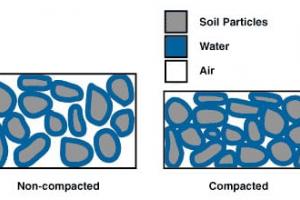
As water is added to a soil ( at low moisture content) it becomes easier for the particles to move past one another during the application of the compacting forces. As the soil compacts the voids are reduced and this causes the dry unit weight ( or dry density) to increase. Increased compactive effort enables greater dry unit weights to be achieved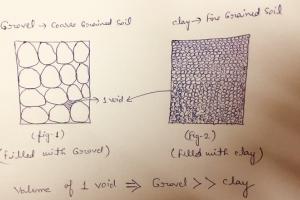
Comparison of Coarse-Grained and Fine-Grained Soils for Engineering Use
The main groups of soils for engineering purposes are coarse-grained soils — sand and gravels — and fine-grained soils — silts and clays. It is important to know the differences between fine-
Unified Soil Classification System and Its Engineering Applications
The Unified Soil Classification System is based on the airfield soil classification system developed by Casagrande during World War II. With some modification it was jointly adopted by several U.S. government agencies in 1952. Additional refinements were made and it is currently standardized as ASTM D 2487-93. It is used in the U.S. and much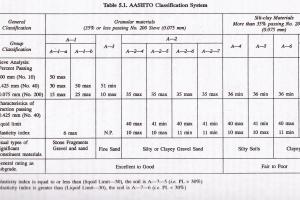
AASHTO Soil Classification System - AASHTO Chart
The AASHTO Soil Classification System classifies soils into seven primary groups, named A-1 through A-7, based on their relative expected quality for road embankments, sub-grades, sub-bases, and bases. Some of the groups are in turn divided into subgroups, such as A-1-a and A-1-b. Furthermore, a Group Index may be calculated to quantify
Unconfined Compression Test - UC Test
The primary purpose of this test is to determine the unconfined compressive strength, which is then used to calculate the unconsolidated undrained shear strength of the clay under unconfined conditions. According to the ASTM standard, the unconfined compressive strength (qu) is defined as the compressive stress at which an unconfined cylindrical specimen of
General Considerations and Assumptions in the Soil Stability Analysis
There are three distinct parts to an analysis of the stability of a slope. They are:. If the analysis is for a natural slope, it is essential that the sample be undisturbed. In such important respects as rate of shear application and state of initial consolidation, the condition of testing must represent as closely as possible the most unfavorable conditions ever likely
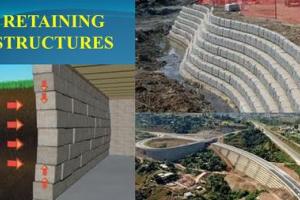
Active Earth Pressure on Retaining Wall
Consider an element at a depth z below the ground surface, When the wall is at the point of moving away (Outwards) from the backfill, there are two kinds of pressure acting on it. In this case the sand back-fill behind the retaining wall is saturated with water. The lateral pressure is made up of two components: Lateral pressure due to submerged weight (gamma)
Effects of Density and Moisture on Soil Behaviour
Particles of fine grained soil are more influenced by variation in moisture content then by any other course. Soils that have ample supporting power under one set of moisture condition may be entirely unsatisfactory if the percentage of moisture change. From study of soil it in observed that between the dry state and where moisture demand is satisfied the volume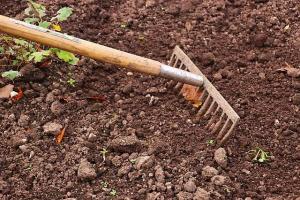
Characteristics of Soil Particles
The predict the sub grade performance of the given soil. As the purpose of the sub grade is to given adequate support to the pavement thus the sub grade should posses’ sufficient stability under the adverse climate and loading conditions. Consists largely of mineral matter formed by the disintegration or decomposition of rocks, caused by the action of water,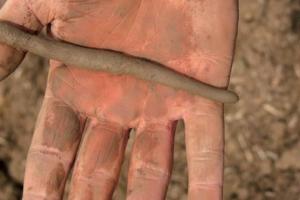
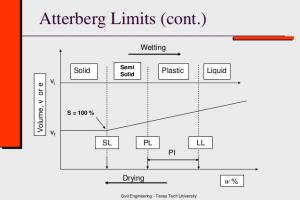
To Determine Liquid Limit of Soil & Plastic Limit of Soil
Liquid Limit Device ‑ a mechanical device consisting of a brass cup suspended from a carriage designed to control its drop onto a hard rubber base. The device may be operated by either a hand crank or electric motor. Cup ‑ brass with mass (including cup hanger) of 185 to 215 g. Cam ‑ designed to raise the cup smoothly and continuously to its maximum height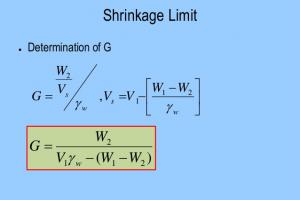
To Determine The Shrinkage Limit of Soil
Shrinkage dish, electric oven, mercury, electric balance, sieve#40, spatula and containers. Take a soil sample passing through sieve#40 and add some amount of water in it to form a thick uniform paste. Take the shrinkage dish, weigh it, and put some of the soil mixture in it by spatula, fill it and again weigh it. Place the shrinkage dish in the oven for 24hours.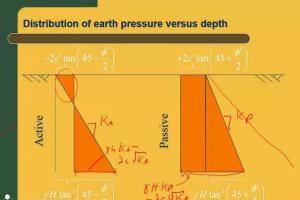
Rankine's Assumptions for Earth Pressure Theory for Active/Passive Pressure
As originally proposed, Rankine's theory is applied to uniform cohesion-less soil only. Later it was extended to include cohesive soil by Bell in 1915. The following cases of active earth pressure on cohesionless backfill will now be considered: Dry or moist backfill Submerged backfill Partly submerged backfill Backfill with uniform surcharge Backfill with sloping surcharge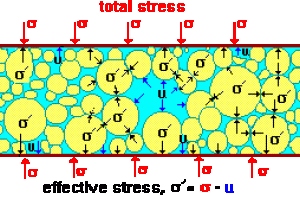
Methods to Determine Stress in Soil
Both immediate and consolidation settlement analysis requires estimate of increase in pressure (ΔHσ) in the soil layers from the applied loads. Several methods are available to estimate the increase in pressure at any depth z from the applied load. We will discuss: 2h: 1v Slope Method An early method is to use 2 (horizontal): 1 (vertical) slope as shown in figure.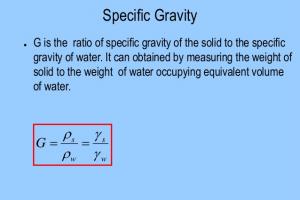
To Determine the Specific Gravity of Soil
Take at least 25g of soil which has been passed through sieve#4 and place it in an oven at fixed temperature of 105-110C0for 24hours to dry it completely. Clean and dry the pycnometer thoroughly and find its mass (M1). Find the mass (M2) of pycnometer by placing dried soil in it. Add sufficient quantity of water to fill the pycnometer up to the given mark and then