Atterberg Limits of Soil Classification - Atterberg Test

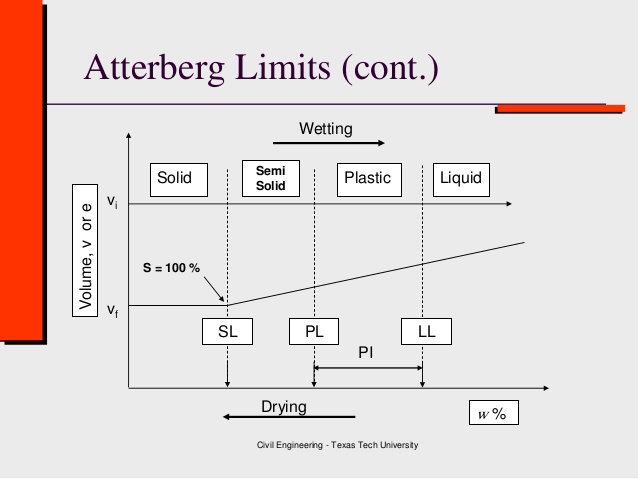
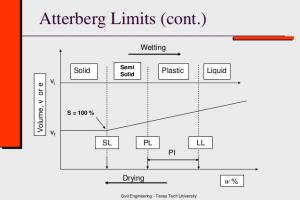
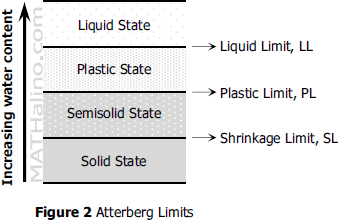
A fine-gained soil can exist in any of several states; which state depends on the amount of water in the soil system. When water is added to a dry soil, each particle is covered with a film of adsorbed water. If the addition of water is continued, the thickness of the water film on a particle increases. Increasing the thickness of the water films permits the particles to slide past one another more easily. The behavior of the soil, therefore, is related to the amount of water in the system. Approximately sixty years ago, Albert Atterberg defined the boundaries of four states in terms of "limits" called Atterberg Limits which are as follows:
Atterberg Limits Definitions
-
Liquid limit: The boundary between the liquid and plastic states;
-
Plastic limit: The boundary between the plastic and semi-solid states;
-
Shrinkage limit: The boundary between the semi-solid and solid states.
 Procedure for Determination of Liquid Limit | Procedure for Determination of Plastic Limit
Casagrande's Definition
These limits have since been more definitely defined by A. Casagrande as the water contents which exist under the following conditions:
-
Liquid limit: The water content at which the soil has such a small shear strength that it flows to close a groove of standard width when jarred in a specified manner.
-
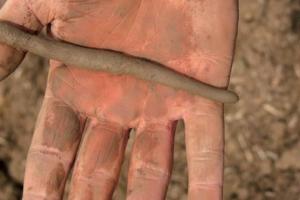
Plastic limit: The water content at which the soil begins to crumble when rolled into threads of specified size.
-
Shrinkage limit: The water content that is just sufficient to fill the pores when the
Liquid Limit Definition
The Liquid Limit, also known as the upper plastic limit, is the water content at which soil changes from the liquid state to a plastic state. OR
It is the minimum moisture content at which a soil flows upon application of very small shear force. OR
The moisture content at which any increase in the moisture content will cause a plastic soil to behave as a liquid. The limit is defined as the moisture content, in percent, required to close a distance of 0.5 inches along the bottom of a groove after 25 blows in a liquid limit device.
Liquid Limit (LL or wL) - the water content, in percent, of a soil at the arbitrarily defined boundary between the semi-liquid and plastic states.
Plastic Limit Definition
The Plastic Limit, also known as the lower plastic limit, is the water content at which a soil changes from the plastic state to a semisolid state. OR
The soil moisture content at which any increase in the moisture content will cause a semi-solid soil to become plastic. The limit is defined as the moisture content at which a thread of soil just crumbles when it is carefully rolled out to a diameter of 1/8 inch. The plastic limit is defined as the moisture content where the thread breaks apart at a diameter of 3.2 mm (about 1/8 inch). A soil is considered non-plastic if a thread cannot be rolled out down to 3.2 mm at any moisture possible.
Plastic Limit (PL or wP) - the water content, in percent, of a soil at the boundary between the plastic and semi-solid states.
Plasticity of Soil
It is defined as the property of cohesive soil which posses the ability to undergo changes of shape without rupture or a change in volume.
Non plastic soils
Soil that do not have plastic limit are reported as being non-plastic e.g fairly clean sand, rock dust etc. Non plastic soils make excellent road materials when properly confined under wearing course .e.g. Rock dust. Even when wet they form hard, durable surface whereas clean sand displaces easily under the load. However, their use for base course or for fill brings difficult construction problems.
Plasticity Index (PI)
Plasticity Index is the range of water content over which a soil behaves plastically. It indicates the degree of plasticity of the soil. PI is the difference between the liquid limit and the plastic limit. Greater the difference, greater is the plasticity of the soil. Soils with a high PI tend to be predominantly clay, while those with a lower PI tend to be predominantly silt. Soils with high plasticity index are highly compressible. Plasticity index in also a measure of cohesiveness with high value of PI indicating high degree of cohesion. Experience shows that soils with high P.I are much less desirable for sub grade or base course than those having less indexes. For base course common specification is P.I < 3.
Shrinkage Limit
It is the maximum water content at which a reduction in water content will not cause a decrease in volume of the soil mass. It is the lowest water content at which soil can still be saturated.
Liquidity Index / Water Plasticity Ratio
The Atterberg limits are found for re-moulded soil samples. These limits as such do not indicate the consistency of undisturbed soil. The index to indicate consistency of undisturbed soils is called liquidity index of the soil or Water Plasticity Ration of the soil. Its advantage is that The liquidity index (LI) is used for scaling the natural water content of a soil sample to the limits.
Flow Index
The curve obtained from the graph of water content against the log of blows while determining the liquid limit lies almost on a straight line and is known as the flow curve. The equation for flow curve is:
W = - If Log N + C
Where 'If is the slope of flow curve and is termed as "Flow Index"
Toughness Index
The shearing strength of clay at plastic limit is a measure of its toughness. It is the ratio of plasticity index to the flow index. It gives us an idea of the shear strength of soil.