Experimental study of Laminar, Transitional and Turbulent Flow

Apparatus:
- Hydraulic bench
- Osborne Reynolds apparatus
- Dye
Osborne Reynolds apparatus includes the following parts:
- Support columns
- Visualization pipes
- Outlet control valve
- Needle
- Reservoir
- Marble glasses (kanchi) for smoothness of flow
- Starter
- Overflow pipe
- Inlet pipe
- Dye reservoir
- Bil mouth
- Dye control valve
Types of Flows and Concepts of Flows
Laminar flow:
The type of flow in which the particles move in a straight line in the form of a thin parallel sheets is known as the Laminar flow. Laminar flow denotes a steady condition where all stream lines follow parallel paths. Under this condition, the dye will remain easily identifiable as a solid core.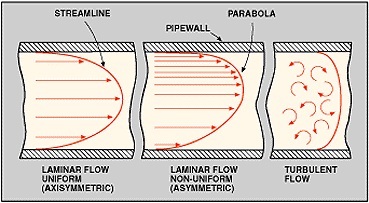
Turbulent flow:
The type of flow in which the particles move in a zigzag pattern is known as the turbulent flow. Turbulent flow denotes as unsteady condition where stream lines interact causing shear plan collapse and mixing occurs. As the flow rate is increased, the transition from laminar to turbulent flow is a gradual process. This zone of change is defined as transitional flow. This will appear as a wandering dye stream prior to dispersion as turbulence occurs.
Transitional flow:
When the flow changes from laminar to turbulent or vice versa a disturbance is created, it is called as the transitional flow.
Open channel flow:
When flow is exposed to the environment whether in pipes or open then it is called as the open channel flow.
Closed channel flow:
When flow is not directly exposed to the environment then it is called as the closed or pipe flow.
There are two ways to categorize a flow:
- By visualization
- By calculation
When liquid flows there are three forces acting on it:
- Inertial force
- Gravitational force
- Viscous force
Reynold's Number:
It is the ratio of inertial force to the viscous force. Mathematically it is given as
RN = v * D/ט If
1) RN = 0 to 2000
Then flow will be laminar.
2) RN = 2000 to 4000
Then flow will be transitional.
3) RN = greater than 4000
Then flow will be turbulent.
Procedure of the Experiment:
-
I filled the reservoir with dye.
-
I positioned the apparatus on the bench and connected the inlet pipe to the bench feet.
-
Then I lowered the dye injector until it was just above the bell mouth inlet.
-
I opened the bench inlet valve and slowly filled head tank to the overflow level, then closed the inlet valve.
-
Then I opened and closed the flow control valve to admit water to the flow visualization pipe.
-
I opened the inlet valve slightly until water traveled from the outlet pipe.
-
I fractionally opened the control valve and adjusted dye control valve until slow flow with dye indication is achieved.
-
At low flow rates the dye was drawn through the center of the pipe.
-
I increased the flow rate that produce eddies in the dye until the dye completely dispersed into the water.
-
I visually observed the three types of flow.
-
When the dye was looking like a line then I categorized it as Laminar flow.
-
When the dye was looking dispersed I categorized it as Turbulent flow
-
When the dye was looking like a line at some instant and dispersed at some times I categorized it as Transitional flow.